Date: June 17, 2025
Time: 01:00 PM EST
Platform: Online | Zoom Meetings
Certificate of Attendance
Continuing Education Credits: Certificates of attendance will be provided to professionals attending the live one-hour webinar.
Important: Participants who attend the live session are eligible to receive a certificate of attendance. Please note that acceptance of this certificate for continuing education or professional development purposes is subject to the specific requirements of each organization or regulatory body. Water Services and Technologies cannot guarantee its acceptance. Certificates will not be issued for those who only view the webinar recording.
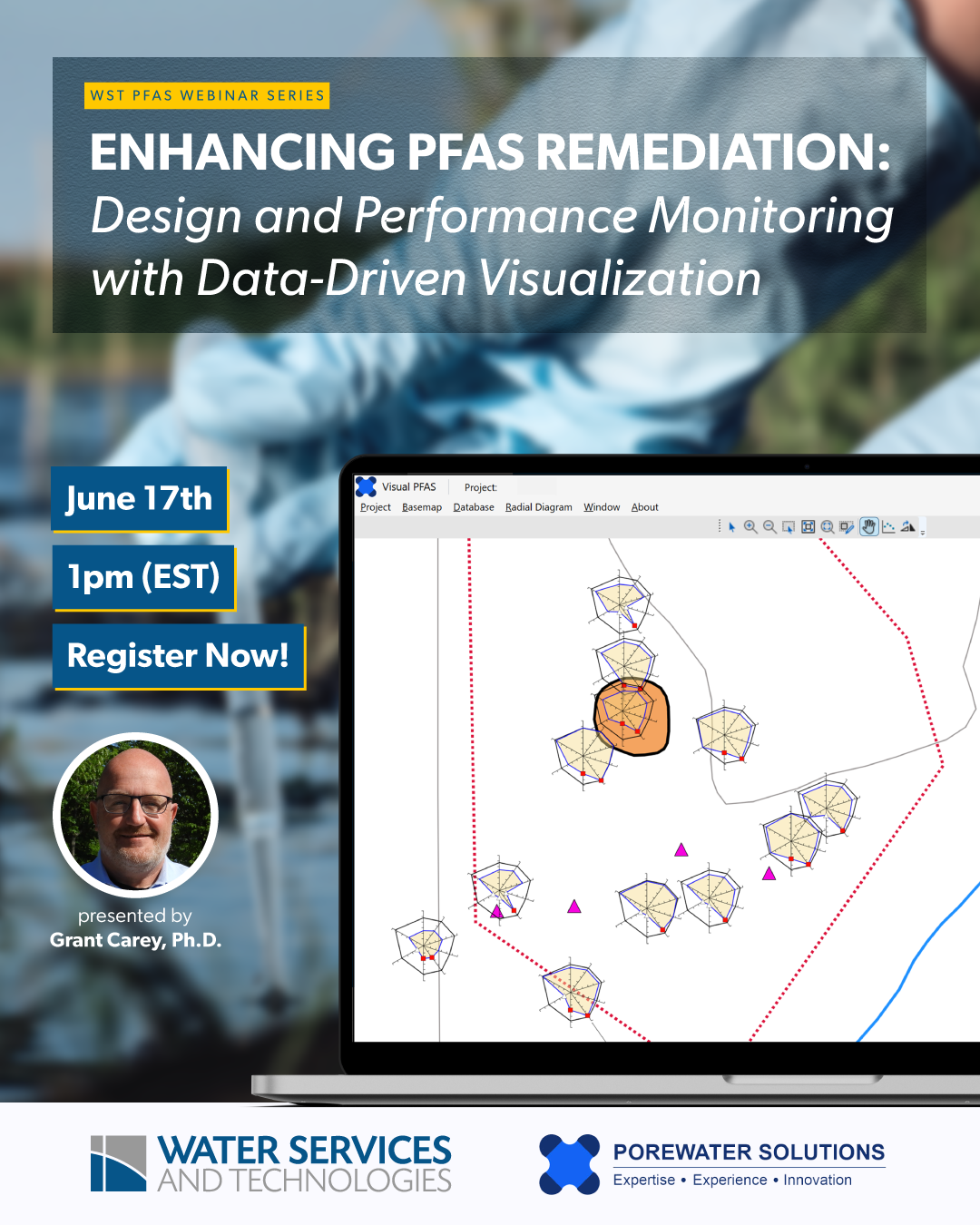
Visual PFASTM radial diagrams and stacked bar maps provide important tools for evaluating the complex datasets associated with PFAS in-situ remediation. This webinar presents a detailed case study where PlumeStop® was successfully used to form a permeable sorption barrier, including:
The use of Visual PFASTM for evaluating in-situ PFAS remediation performance is shown in a hands-on demonstration with an example site.
Gain practical insights from a real-world case study on in-situ PFAS remediation using PlumeStop®.
Understand critical design factors that influence the effectiveness and longevity of sorption barrier systems.
Learn how to recognize potential pitfalls of in-situ chemical oxidation and bioremediation related to precursor transformations.
Explore advanced data visualization tools, including radial diagrams and stacked bar maps, to assess remediation outcomes.
Improve your interpretation of redox conditions and PFAS behavior through field-calibrated models and visual analysis techniques.
Environmental consultants, regulators, site managers, military personnel, and academics.

Dr. Grant Carey is President of Porewater Solutions with more than 30 years of experience specializing in the characterization, modeling, and remediation of many impacted sites across North America. Grant also specializes in the development of innovative modeling and visualization tools for conducting PFAS forensic assessments and for evaluating long-term remediation strategies. Grant is currently involved with five SERDP-ESTCP projects where his main research focus is on PFAS transport and remediation. Grant is also an Adjunct Research Professor at Carleton University in Ottawa, Ontario.